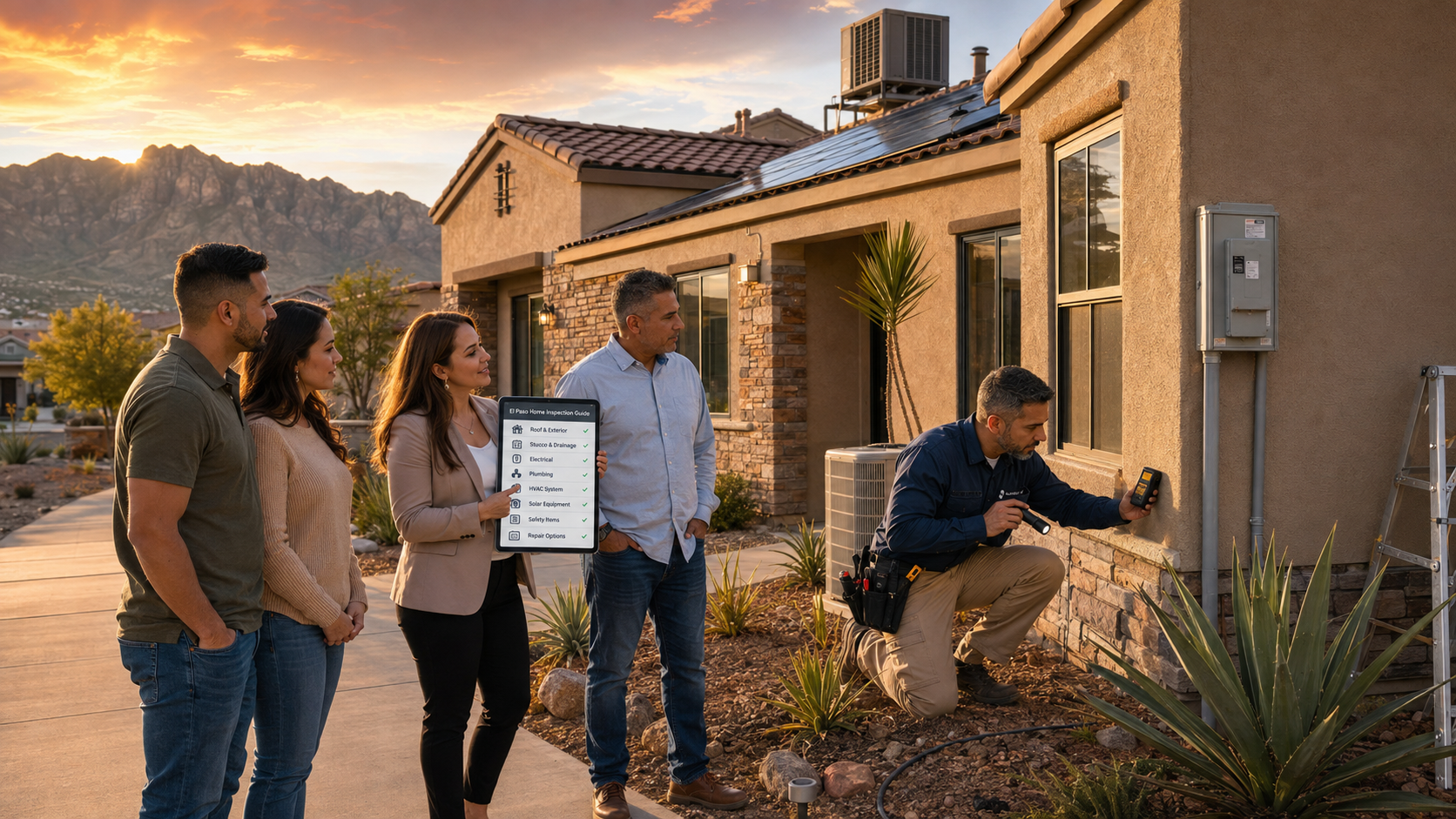
Home Inspection Guide for El Paso Buyers | Seller Tips
An inspection can change an El Paso home sale within days. Buyers use it to understand the visible condition; sellers use the findings to decide whether to repair, credit, renegotiate, or hold firm. This home inspection guide for El Paso buyers also explains how sellers can prepare.
Casa By Owner Realty LLC is an El Paso, Texas, brokerage that helps El Paso County homeowners sell with full-service representation and reduced-cost options. The family-owned, bilingual company has served the community for more than 25 years.
Quick Answer
A home inspection guide for El Paso buyers should cover the inspector's scope, Texas contract deadlines, specialist evaluations, and local concerns such as stucco, roofs, drainage, HVAC, and solar equipment. The inspection is a limited visual assessment, not a warranty. Buyers should act before their contractual deadline, while sellers should prepare access, documents, and a practical repair strategy.
Key Takeaways
-
A Texas home inspection describes the property's visible condition at the time of inspection; it does not guarantee future performance.
-
The buyer's right to terminate or request changes depends on the signed contract, including any option-period terms and deadlines.
-
El Paso inspections often deserve extra attention to stucco, roof exposure, drainage, cooling systems, solar agreements and desert landscaping.
-
A seller may negotiate repairs, a credit, a price change or no change, subject to the contract, lender and appraisal requirements.
-
Selling as-is does not automatically remove applicable disclosure duties or prevent a buyer from arranging an inspection.
What is a Texas home inspection—and what is it not?
A Texas home inspection is a limited visual survey and basic performance evaluation of accessible systems and components using normal controls. The Texas Real Estate Commission, or TREC, says its Standards of Practice apply to licensed inspectors evaluating substantially completed one-to-four-family properties for prospective buyers or sellers.
TREC-licensed inspectors must follow minimum Standards of Practice and provide their client with the required Property Inspection Report Form, REI 7-6. Buyers can verify a license and disciplinary history through the TREC License Holder Search.
An inspection is not an appraisal, warranty, destructive investigation behind finished surfaces or automatic code-compliance certificate. It also does not replace specialized structural, roofing, plumbing, electrical, pest, environmental, pool, septic, sewer or solar advice when needed.
What does a home inspector check in El Paso?
A standard inspection generally addresses accessible structural, electrical, plumbing, heating, cooling, roof, attic, appliance and site-drainage components required by the TREC Standards of Practice.
Scope varies with accessibility and the agreed services. Sewer cameras, environmental testing devices, drones, and some moisture or elevation tools are not automatically required by the minimum Texas standards. Buyers should ask what is included.
How does the inspection process work in El Paso?
The inspection process follows the contract calendar, not a universal Texas timeline.
-
Review the signed contract. Confirm the effective date, option fee, option period, access, and deadlines.
-
Hire an inspector promptly. Verify the Texas license, experience, scope, availability, fee, and insurance.
-
Order needed add-ons or specialists. Age, features, and findings may justify a sewer scope, pest report, pool inspection, or foundation, HVAC, roof, solar, septic, or environmental consultation.
-
Make the property accessible. The seller should provide agreed access to utilities and components while securing pets and valuables.
-
Read the full report. Separate safety concerns and active defects from maintenance, normal aging and cosmetic observations.
-
Obtain specialist opinions or estimates. A relevant contractor or specialist may be better suited to diagnose causes and price work.
-
Respond before the deadline. The buyer may accept the condition, seek an amendment, or exercise a contractual termination right. A repair request alone does not extend a deadline.
-
Document agreed work. Written amendments should state obligations clearly. Buyers should review receipts and completed repairs at the final walk-through.
In a commonly used Texas resale contract, a paid option fee can give the buyer an unrestricted termination right during the stated option period. The contract controls, and missed payment or notice deadlines can change the parties' rights. A licensed real estate professional can explain the transaction; legal questions belong with a Texas real estate attorney.
How much does an El Paso home inspection cost, and how long does it take?
Cost and timing vary by size, age, condition, systems, outbuildings, and optional services. Pools, sewer scopes, pest reports, and other evaluations may involve separate providers and fees.
Ask for a written quote and scope. The inspection may take several hours, and report delivery varies. Buyers should leave time for follow-up before the contract deadline.
What should El Paso sellers do before the inspection?
Sellers should focus on access, accurate disclosures, documents, and known maintenance rather than trying to make an older home appear new.
-
Repair active leaks, unsafe conditions, and simple functional defects when practical.
-
Replace dirty HVAC filters and confirm ordinary controls are accessible.
-
Clear reasonable access to the attic hatch, electrical panel, water heater, HVAC equipment, and under-sink plumbing.
-
Keep utilities connected when the contract requires systems to be available for inspection.
-
Gather roof, HVAC, plumbing, foundation, solar, pool, warranty and repair records.
-
Locate any solar loan, lease, power-purchase, payoff, or transfer information.
-
Prepare applicable HOA resale documents and information about known assessments.
-
Disclose known material facts as Texas law and the contract require; do not conceal stains, cracks or prior repairs.
TREC's current Seller's Disclosure Notice is Form 55-1, effective May 28, 2026. TREC describes it as required for sellers of previously occupied single-family residences covered by Texas Property Code Section 5.008. Exceptions and property-specific duties may apply, so sellers should obtain transaction-specific advice.
Should you repair the home, offer a credit, or sell as-is?
The best response depends on safety, cost, financing, buyer priorities, seller cash, market leverage, and the signed contract.
| Response | When it may fit | Seller consideration | Buyer consideration |
|---|---|---|---|
| Complete repairs | Scope is clear, and a qualified provider is available | Seller controls scheduling but assumes completion risk | Buyer receives work before closing but should review documentation |
| Seller concession or repair credit | Buyer prefers to manage work after closing | Amount and eligibility depend on the contract and lender | Credit may reduce closing cash but may not cover post-closing work dollar for dollar |
| Price reduction | Both parties want a simple value adjustment | Lowers sale price rather than requiring work | May reduce the loan balance but usually does not create immediate repair cash |
| Continue as-is | Price and terms already account for condition | Does not erase applicable disclosure duties | Buyer accepts condition subject to remaining contractual rights and lender requirements |
A seller concession is the value the seller agrees to provide toward a buyer's permitted transaction costs, subject to contract and lender limits. Buyers and sellers should not assume a requested credit will be approved until the lender and title professionals review it.
What local El Paso conditions deserve special attention?
El Paso's desert climate, housing ages, and neighborhood development patterns create local considerations—not universal defects.
-
Stucco and drainage: Small surface cracks may be maintenance items; wider, displaced, or moisture-related cracking may justify specialist review. Short, intense storms can concentrate water near foundations.
-
Roofs and exterior equipment: Sun, wind, temperature swings and occasional hail can affect roof coverings, sealants and rooftop HVAC components.
-
Refrigerated air versus evaporative cooling: Buyers should identify the installed system, test accessible functions under suitable conditions, and review age and maintenance. Conversion quality varies by property.
-
Solar panels: Confirm ownership, financing, transfer terms, roof penetrations, warranties, and utility documentation. An inspector's visual review does not replace contract or solar-system analysis.
-
Older and newer homes: Some established Central, West, Northeast, Upper Valley and Lower Valley properties may have older electrical, plumbing or additions. East El Paso, Far East El Paso and Horizon City buyers may compare resales with builder inventory, but new homes can still benefit from inspection.
-
Location-specific systems: Some Canutillo, Upper Valley, Lower Valley, or Socorro-area properties may involve pools, irrigation, septic or private-water components. Verify the actual property instead of assuming from the area.
-
Military timing: Near Fort Bliss, a PCS (permanent change of station) schedule can make inspection access and repair estimates time-sensitive. Urgency should not replace written deadlines.
An inspection does not determine property taxes, school suitability, or commute quality. Buyers should separately review the El Paso Central Appraisal District property search, HOA information, schools relevant to their household, and access to Interstate 10 or Loop 375.
What mistakes should homeowners avoid?
Sellers should avoid hiding defects, making cosmetic coverups, using unqualified repair providers, treating every item as major or ignoring deadlines. Another mistake is negotiating only the repair total instead of estimated net proceeds—the amount remaining after mortgages, agreed costs, concessions, and closing charges.
Buyers should avoid treating the report as a pass-fail score, demanding that every older component meet new-construction expectations, skipping specialists when the report recommends them, or assuming a repair request changes the contract automatically.
When should you contact a real estate professional?
Sellers should seek advice before listing if inspection risk could affect pricing, disclosure, or preparation decisions, and immediately after receiving an inspection-related request.
Casa By Owner's seller services include local pricing strategy, preparation guidance, inspection negotiation, and contract-to-close coordination. Casa By Owner Realty LLC provides professional real estate service for less through full-service discount realty, with practical bilingual explanations for El Paso homeowners.
Plain-English real estate definitions
-
Seller disclosure: a seller's written statement about specified property conditions and known facts when required.
-
Option period: a contractually stated period during which a buyer may have an unrestricted right to terminate after timely payment of the option fee.
-
Appraisal: a licensed appraiser's opinion of value, often obtained for the lender; it is separate from an inspection.
-
Discount realty: brokerage representation offered at a reduced cost; it may be full service or limited service, depending on the agreement.
-
Multiple Listing Service (MLS): a professional database used by participating brokers to share listing information.
Conclusion: prepare for the inspection, not a perfect report
The most useful home inspection guide for El Paso buyers recognizes that nearly every property will have observations. The goal is to understand material concerns, meet contract deadlines, and choose a proportionate response. Sellers can reduce friction through accurate disclosures, access, records, realistic pricing, and a repair strategy suited to the home and the current El Paso market.
Discuss your El Paso selling strategy
Casa By Owner Realty LLC helps homeowners compare repairs, an as-is sale, MLS exposure, and other selling options with clear explanations and professional representation. Request a no-pressure El Paso home-value consultation, discuss pricing, estimate net proceeds or ask how full-service discount realty can reduce selling costs. Call 915-587-4670 to speak with a local Casa By Owner real estate professional in English or Spanish.
Frequently Asked Questions
Is a home inspection required when buying a house in Texas?
No. A general home inspection is usually a buyer's due-diligence choice rather than a universal requirement for every Texas sale. However, a buyer's contract, lender, or property type may create related requirements. The buyer's termination rights and deadlines depend on the signed contract. Buyers should arrange inspections promptly and confirm deadlines with their agent or attorney.
Can an El Paso seller refuse to make repairs after the inspection?
Yes. A seller can generally decline a buyer's repair request unless the contract already requires specific work or another obligation applies. The buyer may still have rights under the option period, financing addendum, or other contract terms. The parties can negotiate repairs, credits, price, timing, or no change. Any agreement should be written properly.
Does selling a Texas home as-is eliminate disclosure duties?
No. An as-is provision addresses the condition the buyer agrees to accept; it does not automatically eliminate disclosure duties imposed by Texas law or the contract. Sellers should accurately complete applicable disclosures and avoid concealing known material facts. Because exemptions and facts vary, a licensed professional or Texas real estate attorney should address a specific property.
Should an El Paso seller order a pre-listing inspection?
It depends. A pre-listing inspection may help a seller identify problems, plan repairs, and price with better information. It can also create new information that may need to be evaluated or disclosed. It may be useful for inherited property, an older home, or an absentee owner, but it is not automatically the right choice for every listing.
Do new-construction homes in El Paso need an inspection?
New homes can still benefit from an independent inspection. Workmanship issues, incomplete items, or system deficiencies can occur even when the home has passed municipal stages. Buyers should review the builder contract, inspection-access rules, and warranty deadlines. If allowed, buyers may consider phase inspections and a final inspection; the scope depends on construction progress and the inspector's services.
Who receives the buyer's inspection report in Texas?
The inspector's client receives the report. TREC rules state that inspectors generally may not disclose inspection results or client information without the client's prior approval, with a limited safety-hazard exception. A seller may receive selected pages, repair language or the entire report if the buyer provides it. Sellers should review what was delivered before responding.
Is a home inspection the same as an appraisal?
No. An inspection evaluates the visible condition and basic performance of accessible systems; an appraisal estimates market value for a client, often a lender. Inspection findings can indirectly affect financing if a lender or appraiser identifies required repairs, but one report does not replace the other. The loan program and property condition may influence what must be completed before closing.
How long does an El Paso home inspection take?
It varies. Property size, age, condition, accessibility, and optional systems affect the on-site time. A larger home with a pool or detached structures may take longer than a smaller property. Report delivery time also varies by inspector. Buyers should schedule early enough to obtain specialist opinions and make written decisions before their contractual deadlines.
Should buyers attend the home inspection?
Attendance policies vary, but buyers often benefit from being present for the inspector's summary or another agreed portion. Seeing the location and context of a finding can make the written report easier to understand. Buyers should follow the inspector's safety rules and avoid interrupting the evaluation. The report—not an informal conversation—should guide follow-up questions.